
What shared engineering culture looks like in real collaboration workflows.
Concrete norms from live engagements: shared workspaces, equal ceremony standards, clear documentation, and ownership through resolution.
Many “nearshore” programmes accidentally build a vendor wall: separate chat spaces, duplicate issue trackers, and a ticket router between customer engineers and India. The wall lowers trust, raises latency, and hides quality problems until they become production incidents. The alternative is co-employment in practice: India behaves as part of your engineering organisation even where employment sits with a partner.
Collaboration workflows that actually scale
Start with workspace truth: channels, repositories, and runbooks live where your organisation already works. If India has to “translate” status into a second system, you have introduced a tax on every sprint. Second, define overlap as capacity: protect a daily window for resolving ambiguity live. Async is essential; async alone does not remove coordination debt.
Sprint rituals: parity, not theatre
Planning, review, and retrospective formats should be identical across regions. If headquarters runs blameless post-incident reviews in a specific template, India should use the same template—not a shortened vendor variant. Parity signals seriousness and reduces hidden rework.
Documentation and product delivery
Documentation is where culture becomes durable. When design decisions live only in headquarters tools, India engineers optimise locally and drift accumulates. Centralise decision logs, architecture decision records, and customer context links in systems everyone can reach with the same entitlement model.
| Ceremony | Parity test |
|---|---|
| Sprint planning | India voices commitments with same granularity as HQ squads |
| Incident response | India lead can command until resolution without ticket escalation |
| Architecture review | Same bar, same reviewers, same written outcomes |
Suggested visual
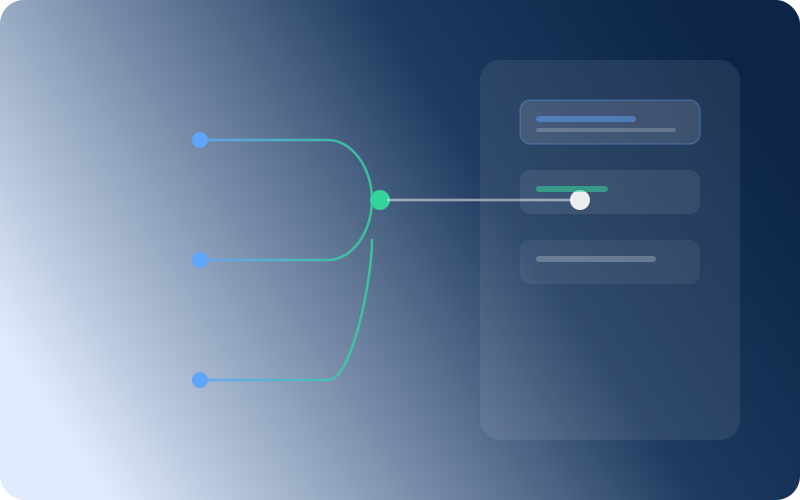
Diagram: single control plane for engineering truth
- One IdP, one repo organisation, one incident workflow.
- Annotate “overlap window” as a protected capacity pool, not leftover calendar.
- Show documentation and customer context flowing into the same knowledge graph.
Strategic recommendations
Assign explicit ownership for cross-region communication quality—usually a principal engineer or director—not a programme office that only tracks status. Publish a short set of non-negotiables: where work is discussed, how incidents are commanded, and how customer context is recorded. Then audit reality quarterly against those non-negotiables with samples, not surveys alone.
When something breaks at 2 a.m. UK time, the test is simple: does your India engineering leader own the narrative until resolution? If the answer is yes, you are closer to a shared culture than most programmes ever reach. If the answer is no, tooling investments will not fix the trust gap.